Help & advice
Where should bins go in a kitchen?
Last updated: March 30, 2026
Oops - a common after thought!
Bins are one of the most used parts of a kitchen. Get it wrong and you will notice it every day.
The key principle
Bins should be placed where waste is created, not wherever there happens to be space.
That usually means:
- Close to the main food prep area
- Near the sink and dishwasher
This keeps everything practical when cooking and cleaning. Chop, scrape, rinse under the tap (if you do that...), into the dishwasher.
Built-in or freestanding bin?
You need to go fairly deep into your kitchen planning to get this right first time, so yes this is a thing. Ideally, a built-in bin situation is going to give you the cleanest kitchen layout.
Built-in bins are hidden inside cabinets / integrated in kitchen units and easier to successfully position exactly where you need them as they are given a dedicated space in your plan.
Freestanding bins can obviously go anywhere, but you'll still need them close to where the mess happens.
A quick note on retrofitting: You want to avoid retrospectively attaching a bin to a door as inevitably the weight of the bin and material of the doors means that this can wear out.
Types of bins to think about
- General waste
- Recycling (glass, cardboard, some plastics etc.)
- Food waste
- Plastic bags for the supermarket recycling?
- … what else?
It's worth listing this out. Different areas handle recycling differently, so use your kitchen layout as an opportunity to keep everything in one place rather than spreading it across the house.

Space to allow
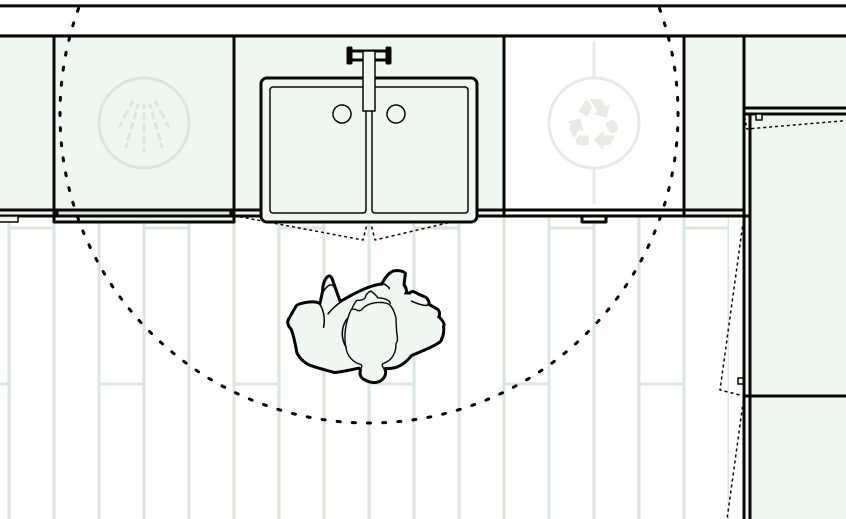
Typical cabinet widths for bins go from 300-600mm.
For clearance in front:
Treat 900mm as your bare minimum for anything used daily (sink, bins, dishwasher, fridge), so doors can open fully and the space is comfortable to use.
Things people don't think about
But you will now...
- How far it is from where food is prepared
- How far it is from where clean up happens
- Whether it actually works for how you separate recycling and waste
The takeaway
Where should the bins go? Plan it around how you actually use the space, and you'll avoid a daily frustration that's going to be hard to fix later.
Frequently asked questions
Where should a bin be placed in a kitchen?
A kitchen bin should be placed close to the main food prep area and near the sink or dishwasher. This keeps waste disposal practical while cooking and cleaning, reducing the need to move around the kitchen unnecessarily.
What is the best place for a kitchen bin?
The best place for a kitchen bin is between the prep area and the sink, where most food waste is created. This allows you to scrape, rinse and dispose of waste in one natural movement.
Should a kitchen bin be inside a cupboard?
Kitchen bins are often best placed inside a cupboard or pull-out unit to keep the space tidy and integrated. Built-in bins also allow you to position them exactly where they are most practical to use.
How much space do you need for a kitchen bin cupboard?
Kitchen bin cupboards are typically 300-600mm wide, depending on the number of compartments. You should also allow around 900mm clearance in front so the unit can open fully and be used comfortably.
What size cabinet is needed for a pull-out bin?
Most pull-out bin systems fit into cabinets between 300mm and 600mm wide. Smaller units are suitable for single bins, while wider cabinets can accommodate multiple compartments for recycling and food waste.
Can you put a bin under the sink?
Yes, bins are often placed under the sink because it is close to both food prep and clean-up areas. However, space can be limited by pipework, so it is important to check what will realistically fit.
How do you organise recycling in a kitchen?
The best way to organise recycling in a kitchen is to plan separate compartments for general waste, recycling and food waste within one bin unit. This avoids having multiple bins in different areas of the home and keeps everything easy to manage.
Where do you put a bin in a small kitchen?
In a small kitchen, the bin is best placed inside a cupboard near the main prep and sink / dishwasher area. Pull-out bin units help keep the space tidy while still being easy to access.
Is it better to have a pull-out bin in a kitchen?
Pull-out bins are usually better for modern kitchens because they are hidden, space-efficient and positioned exactly where you need them. They also make it easier to separate recycling and food waste.
Should a kitchen bin be near the sink or the hob?
A kitchen bin should be closer to the prep area and sink, rather than the hob. Most waste is created during food preparation and cleaning, not during cooking.
Can you have a bin in a kitchen island?
Yes, bins can work very well in a kitchen island, especially if the island is used for food preparation. This can reduce movement between zones and make the kitchen more efficient to use.
What is the most practical kitchen bin setup?
The most practical setup is a built-in bin with separate compartments for general waste, recycling and food waste, positioned near the prep and sink / dishwasher area.
Renovating? Read more...
Kitchen
Planning the best layout for your kitchen
One of the first steps in kitchen planning is understanding the room's physical features.
Kitchen
Where to put sockets in a kitchen
Planning your kitchen sockets might not be the most exciting part of a renovation, but getting it right makes a huge difference to how easy your kitchen is to use.
Kitchen
The essential guide to kitchen islands
Designing the perfect kitchen island starts with getting the spacing just right. From clearance zones to island dimensions, our guide breaks down everything you need to create a functional and stylish centerpiece for your kitchen.
Kitchen
Pros and cons of different surface materials for the kitchen / utility room
Choosing the right surface materials for your kitchen is crucial for both aesthetic appeal and functionality.
Kitchen
Where should appliances go in a kitchen?
A fridge in the wrong place, a dishwasher too far from the sink, or an oven door blocking a walkway will make a kitchen pretty frustrating to use.
Free tools to get started


Join our mailing list and get 10% off
Who are you? *
By signing up, you are agreeing to our Terms and Privacy Policy including receiving emails from us at Reno (you can unsubscribe at any time). Opted out but want back in? Re-subscribe to the mailing list .
Start your renovation with Reno