Help & advice
How to budget for a home renovation
Last updated: June 25, 2026
Budgeting for a home renovation is difficult! You are usually trying to price something that does not fully exist yet.
You might know you want a new bathroom, a kitchen renovation or a whole-house refurb, but that is not enough detail to build a reliable budget.
A bathroom can be a simple like-for-like replacement...
...or it can involve moving the toilet, replacing rotten joists, changing the electrics, plastering the walls, fitting a wet room, tiling floor to ceiling and installing wall-hung fixtures.
Those are not the same project.
So the aim is not just to pick a number and hope the renovation fits inside it.
The aim is to understand what you are actually planning, what decisions affect the cost and what information trades need before they can quote properly.
Start with the scope, not the number
A lot of renovation budgets start like this:
"We have £20,000. What can we do?" Which is totally understandable, but not the most useful starting point.
A better starting point is "what are we actually changing?".
Before you think about the final budget, get clear on the scope:
- Which rooms are being renovated?
- Is the layout changing?
- Are walls, doors or windows moving?
- Are plumbing positions changing?
- Are electrics being moved or added?
- Are you replacing like for like or upgrading?
- Are you doing any structural work?
- Are floors, walls or ceilings being repaired?
- Who is supplying fixtures and fittings?
- What level of finish are you aiming for?
Until those questions are answered, the budget will be guesswork. Not useless guesswork, but still guesswork.
Read how to plan a home renovation from start to finish to go into depth on the whole planning process.
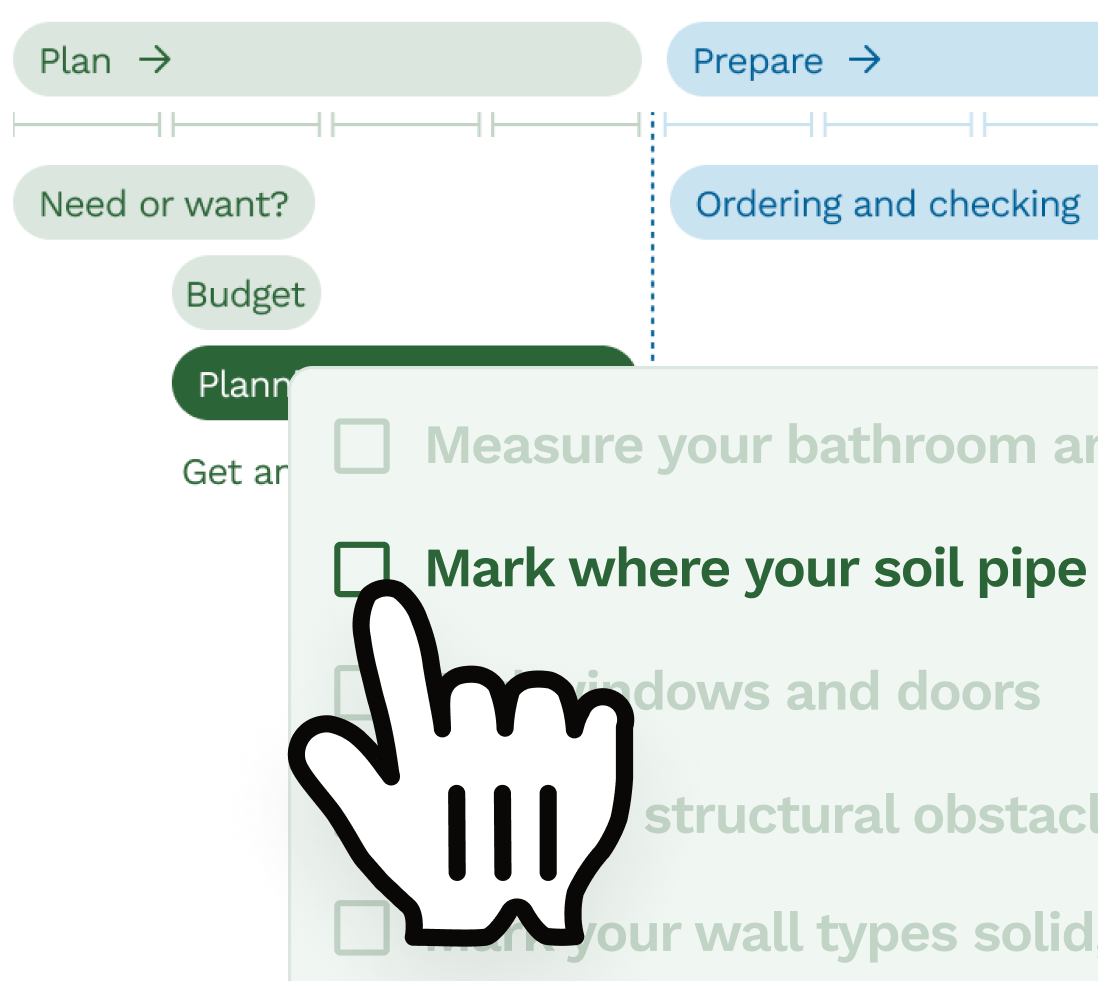
Why renovation budgets go wrong
Most renovation budgets go wrong because the plan is too vague at the start, not because anyone is being lazy or anything like that, but because the level of detail you need to have planned for comes at you thick and fast!
Costs change when you realise:
- The toilet has to move
- The shower controls you want are concealed against a solid wall, not exposed
- The floor needs repairing
- The walls need taken back to brick and plastering
- The consumer unit for your electrics needs updating
- Those hand made tiles are very time consuming to lay
- The radiator is moving across the room
- The room shape needs to change
- The ceiling needs work
- The finish you want takes longer to install
These things are not minor details. They change labour, materials, timescales and the kind of trade work needed.
That is why a renovation budget should be built from the plan, not separate from it.

Use benchmarks carefully
External renovation cost benchmarks can be useful, but they should not be treated as your budget.
For example, Checkatrade's 2026 house renovation guide puts the cost of renovating a 3-bedroom house in the UK between £43,530 and £110,350, with an average of £76,690.
That range is useful because it shows just how much renovation costs can vary.
But it also shows why averages are not enough.
A £50,000 budget might cover the lower end of a 3-bedroom renovation, or it might disappear quickly if the project includes structural work, rewiring, new heating, bathrooms, kitchens, roof repairs or higher-spec finishes.
Use benchmarks as a sense check.
Then build your real budget from your actual plan, specification and quotes.
Use a calculator for an early estimate
This is where a cost calculator can be useful.
Reno's bathroom cost calculator helps you estimate the cost of a bathroom renovation by working through the decisions that actually affect the price.
It asks about things like:
- Location
- Room size
- Layout changes
- Structural changes
- Removal of the old suite
- Wall condition
- Ceiling work
- Sub-floor repairs
- Flooring
- Bath type
- Shower type
- Toilet type
- Basin type
- Taps
- Heating
- Electrics
- Tiling coverage
- Tile size and type
- Room shape
- Painting and decorating
- Furniture and accessories
- Waste removal
That is much more useful than asking "how much does a bathroom cost?" in isolation.
However, a calculator will never replace a quote from a trade. What it can do is help you understand which choices are pushing the budget up before you start asking people to price the work.
Treat the estimate as a planning tool
Calculators like our bathroom calculator are best used early.
They help you spot the expensive decisions:
- Keeping the same layout is usually simpler than moving everything
- Moving a toilet is always more expensive because of the soil pipe
- Concealed showers are usually more complex than exposed showers
- Wet rooms need more preparation than a standard tray and enclosure
- Full-height tiling costs more than splashbacks or half-height tiling
- Small tiles or herringbone patterns usually take longer to fit so cost more
- Repairing walls, floors or ceilings adds cost before new finishes go in
This is useful because it lets you make trade-offs.
You might decide the walk-in shower matters, but the luxury tiles do not.
Or that the wall-hung toilet is worth it, but moving the whole layout is not.
That is what budgeting really is - not just making the number smaller, but making decisions about where the money should go.
Build the plan before asking for quotes
Once you have an early estimate, the next step is not to send a vague message to three builders.
The next step is to make the plan clearer.
Trades can only quote accurately if they understand what they are pricing.
For a bathroom, that might mean showing:
- The room dimensions
- The current layout
- The proposed layout
- What is staying and moving
- Bath, shower, toilet and basin positions
- Tile coverage
- Floor finish
- Wall finishes
- Lighting
- Sockets or shaver points
- Extractor fan position
- Radiator or towel rail position
- What you are supplying
- What you expect the trade to supply
This is where creating a renovation plan on Reno really helps.
You can create an accurate 2D layout, work with wall elevations, add fixtures and fittings, plan sockets, switches, lights and radiators, and build up the detail that turns an idea into a proper brief quickly and easily without having to master CAD.

Read what needs to be decided before first fix for the decisions that need locking in earlier than most people expect.
Use wall elevations to catch the hidden cost decisions
A lot of renovation costs sit in and on the walls, so a layout drawing is just not enough. Wall elevations are a front on view of everything attached to that wall:
- Tile heights
- Splashbacks
- Wall panels
- Mirrors
- Cabinets
- Lighting
- Sockets and switches
- Shower controls
- Towel rails
- Radiators
- Shelving
- Niches
- Skirting and trims
Without elevations, these decisions often happen too late or get missed entirely.
Someone asks where the tiles stop, where the mirror goes or whether the socket is centred to the basin, and suddenly the answer affects labour, materials or finish quality.
Reno connects floor plans and wall elevations automatically, so those decisions are part of the plan rather than separate notes or drawings floating around somewhere else.

Calculate quantities where you can
Some renovation costs are hard to know until a trade sees the job.
But some things can be calculated much earlier.
For example:
- Paint coverage
- Wall areas
- Tile areas
- Floor areas
- Panels
- Trims
- Finishes
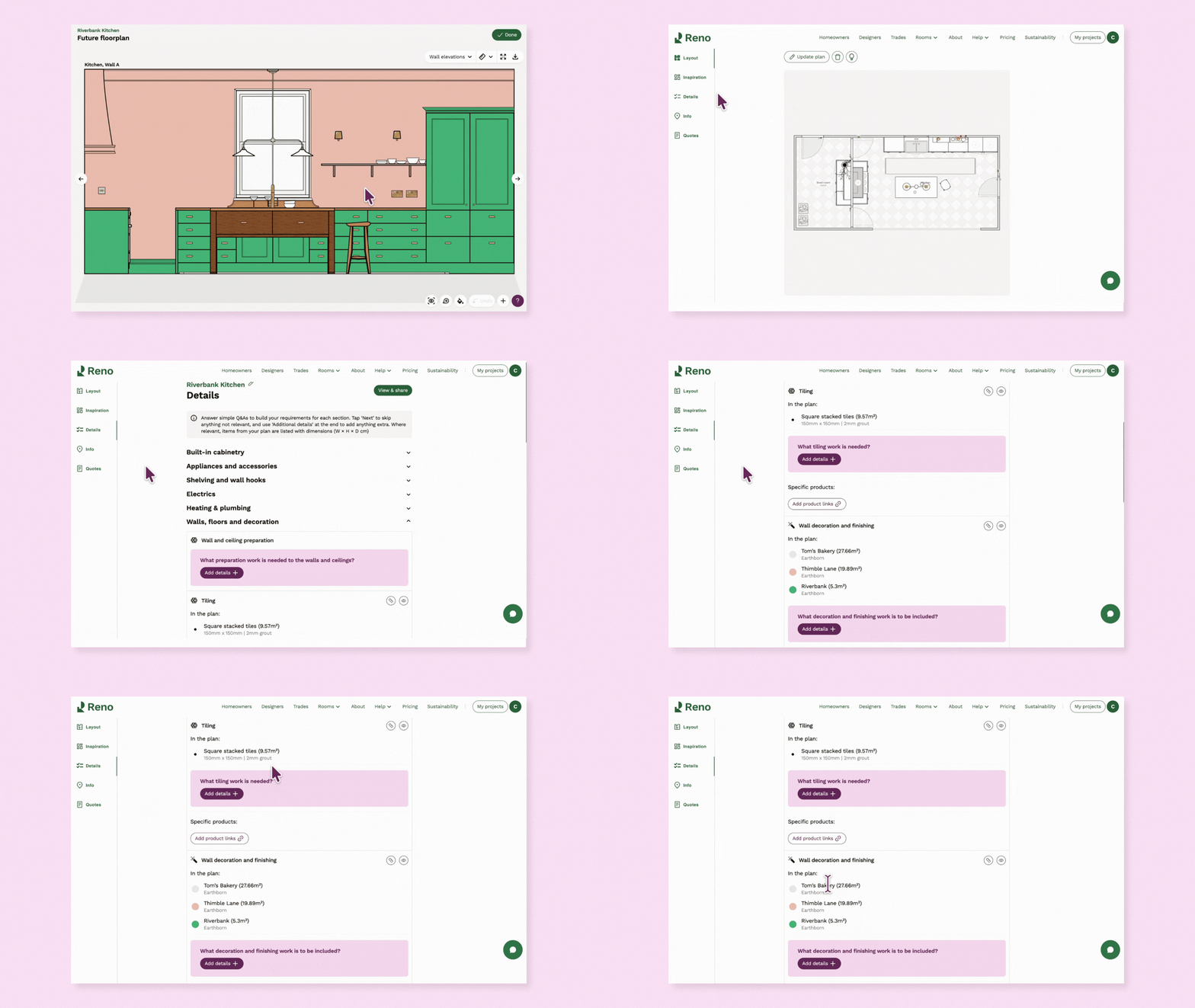
Reno calculates paint and tile coverage from the wall elevations in your plan, taking into account walls, openings and the areas you are decorating.
That matters because a budget is not only labour and big-ticket items.
It is also the accumulation of smaller decisions: paint, tiles, trims, grout, adhesive, panels, accessories and finishes.
These are the things that can quietly grow if nobody has measured properly.
Be clear about who is supplying what
This is a common budget trap.
If you are supplying your own fixtures and fittings, make sure that is clear before quotes are prepared.
You need to know:
- Who is ordering each item
- Who is checking it fits
- Who is checking what parts are included
- Who is responsible for returns if something arrives damaged
- Where it will be stored
- When it needs to be on site
- Whether the trade is happy to install it
A toilet is not always just a toilet.
A bath may need a waste, trap, overflow, panel, feet or special tap arrangement.
A concealed shower may need the valve on site before the wall is closed.
A wall-hung basin or toilet may need frames, fixings, supports or boxing.
If these things are not clear, the quote may not include the full job.
Read things to consider if you are supplying the sanitaryware if you are planning to source bathroom items yourself.
Add contingency, but do not use it as a shortcut
You should always include contingency in a renovation budget.
There are things you cannot fully predict, like discovering rotten joists, old wiring, damp or pipework that needs replacing.
As a rough guide in the UK, Checkatrade, VELUX, HSBC, Federation of Master Builders all recommend adding in the ballpark of 10 to 20% to a house renovation budget for unforeseen issues such as dry rot or rising material costs.
For older homes, structural changes or bigger projects with more unknowns, it is sensible to allow more breathing room and have your contingency land at the top end i.e. 20% or more.
This contingency is not there to cover decisions you could have made earlier. It is not a replacement for planning.
A better approach is:
- Plan as much as you reasonably can
- Get quotes based on a clear brief
- Include contingency for genuine unknowns
- Avoid spending the contingency before work starts
If the contingency has already disappeared into nicer tiles before the first wall is opened up, it is not really contingency anymore.
Get quotes from the same brief
When you ask trades for quotes, make sure each person is quoting from the same information.
That means sharing the same:
- Layout
- Measurements
- Fixture list
- Finishes
- Tile coverage
- Electrical requirements
- Heating requirements
- Notes
- Assumptions
- Supply responsibilities
This is the only way to compare quotes properly.
If one trade has allowed for full-height tiling and another has allowed for splashbacks, those quotes are not comparable.
If one has included waste removal and another has not, the cheaper quote may not actually be cheaper.
The goal is to compare like with like (and that's exactly what you have with a Reno plan.)
Read how do I find good trades for my project? if you are at the quote and comparison stage.
Budgeting room by room
For a whole-home renovation, it can help to build the budget room by room.
Start with the rooms that are most complex:
- Bathrooms
- Kitchens
- Utilities
- Ensuites
Then work through:
- Bedrooms
- Living rooms
- Hallways
- Dining rooms
- Home offices
- Storage areas
Each room should have its own plan, decisions and likely cost drivers.
That makes the whole project easier to understand.
It also helps you decide where to spend and where to simplify.
How to Budget for a Home Renovation
Reno helps you budget more clearly by helping you plan more clearly.
It can help you:
- Create accurate 2D layouts
- Work with wall elevations
- Add fixtures, fittings and furniture to scale
- Plan sockets, switches, lights and radiators
- Show tiles, panels, splashbacks and finishes
- Calculate paint coverage
- Collect product choices
- Answer detailed planning questions
- Build a clearer brief
- Share plans with trades
- Get quotes based on better information
The point is not that software can magically tell you the final cost of a renovation.
It cannot.
The point is that better plans lead to better quotes.
And better quotes lead to better budgets.
The simple budgeting process
If you want a practical order, use this:
- Work out what is changing
- Use benchmarks as a sense check
- Use a calculator for an early estimate
- Create an accurate layout
- Add fixtures, fittings and finishes
- Use elevations to plan wall details
- Calculate quantities where possible
- Decide who is supplying what
- Build a clear brief
- Get comparable quotes
- Add contingency
- Keep tracking changes as the project moves forward
Budgeting is not one job you do at the start and never touch again.
It is part of the renovation planning process.
As the plan gets clearer, the budget should get clearer too.
Frequently asked questions
How do I budget for a home renovation?
Start by working out the scope of the renovation, then build the budget from the plan. List what is changing, create accurate layouts, decide fixtures and finishes, get quotes from the same brief and add contingency for genuine unknowns.
Why do renovation budgets go over?
Renovation budgets often go over because the original plan was too vague. Late decisions, unclear quotes, layout changes, damaged materials, hidden problems and missing items can all add cost once work has started.
Is £50,000 enough to renovate a house in the UK?
It depends on the size, condition and scope of the renovation. Checkatrade's 2026 guide puts a 3-bedroom house renovation between £43,530 and £110,350, so £50,000 may only cover the lower end. A clearer plan, specification and quotes are needed to understand whether that budget matches your project.
Can a renovation cost calculator replace a quote?
No. A renovation cost calculator is useful for early planning and comparing options, but it does not replace a quote from a trade. A proper quote still needs to be based on the room, the condition of the property, the layout, the finishes and the agreed scope of work.
What affects the cost of a bathroom renovation most?
The biggest cost drivers are usually layout changes, moving plumbing, the condition of the walls and floor, shower type, toilet type, tiling coverage, tile choice, electrical work, heating and waste removal.
Why does moving a toilet increase bathroom renovation cost?
Moving a toilet can increase cost because it often depends on the soil pipe position and whether a new waste route can be created. It may affect floors, walls, boxing, plumbing and sometimes the overall bathroom layout.
How can I get more accurate renovation quotes?
Give each trade the same clear brief. Include the layout, measurements, fixtures, fittings, finishes, tile coverage, electrical requirements, heating requirements, supply responsibilities and any known assumptions or exclusions.
How much contingency should I include in a renovation budget?
As a rough guide, many UK renovation sources suggest allowing around 10 to 15% contingency for unexpected costs. For older homes, structural changes or projects with more unknowns, 15 to 20% may be more realistic. Contingency should sit on top of a clear plan and quote, not replace proper planning.
How does Reno help with renovation budgeting?
Reno helps by turning your renovation ideas into accurate plans, wall elevations, product choices, calculated quantities and clearer briefs. That makes it easier to understand the cost drivers and get quotes based on the same information.
Renovating? Read more...
All rooms
How to plan a home renovation project from start to finish
A start-to-finish renovation planning guide covering surveys, scaled plans, approvals, quotes, ordering, communication and snagging.
All rooms
What needs to be decided before first fix?
Pipes and cables are installed inside walls and floors, so changes become expensive and disruptive.
Bathroom
Things to consider if you are supplying the sanitaryware
If you are sourcing your own bathroom items, make sure responsibilities, timings and compatibility are clear before work starts.
All rooms
How do I find good trades for my project?
Start with recommendations where possible, then compare reviews, communication, detail and pricing clarity.
All rooms
Why an accurate floor plan matters so much in a renovation
Why accurate plans matter for quotes, layouts, wall details, first fix decisions and quantities before work starts.
All rooms
Renovation mistakes to avoid before starting your home project
A practical guide to common renovation mistakes, from vague quotes and missed first fix decisions to product fit, quantities and change tracking.
Free tools to get started
Join our mailing list and get 10% off
Who are you? *
By signing up, you are agreeing to our Terms and Privacy Policy including receiving emails from us at Reno (you can unsubscribe at any time). Opted out but want back in? Re-subscribe to the mailing list .
Start your renovation with Reno